Copy Link
The 20% Profit Margin Benchmark: Why Only 20% of Locations Hit It (And How You Can)
Here's a sobering stat: The ideal profit margin benchmark for gyms is 20%. But only about 20% of gyms actually hit it.

Here's a sobering stat: The ideal profit margin benchmark for gyms is 20%. But only about 20% of gyms actually hit it.
That means 80% of gym owners are leaving money on the table, operating inefficiently, or simply don't know what "good" looks like.
And here's the thing: if you're not hitting that benchmark, it's not because you're terrible at business. It's because there are efficiencies you haven't uncovered yet. Variables you haven't optimized. Waste you haven't eliminated.
This Masterclass Mini is about giving you the financial health check framework that separates the struggling 80% from the thriving 20%.
Understanding Profit Margins
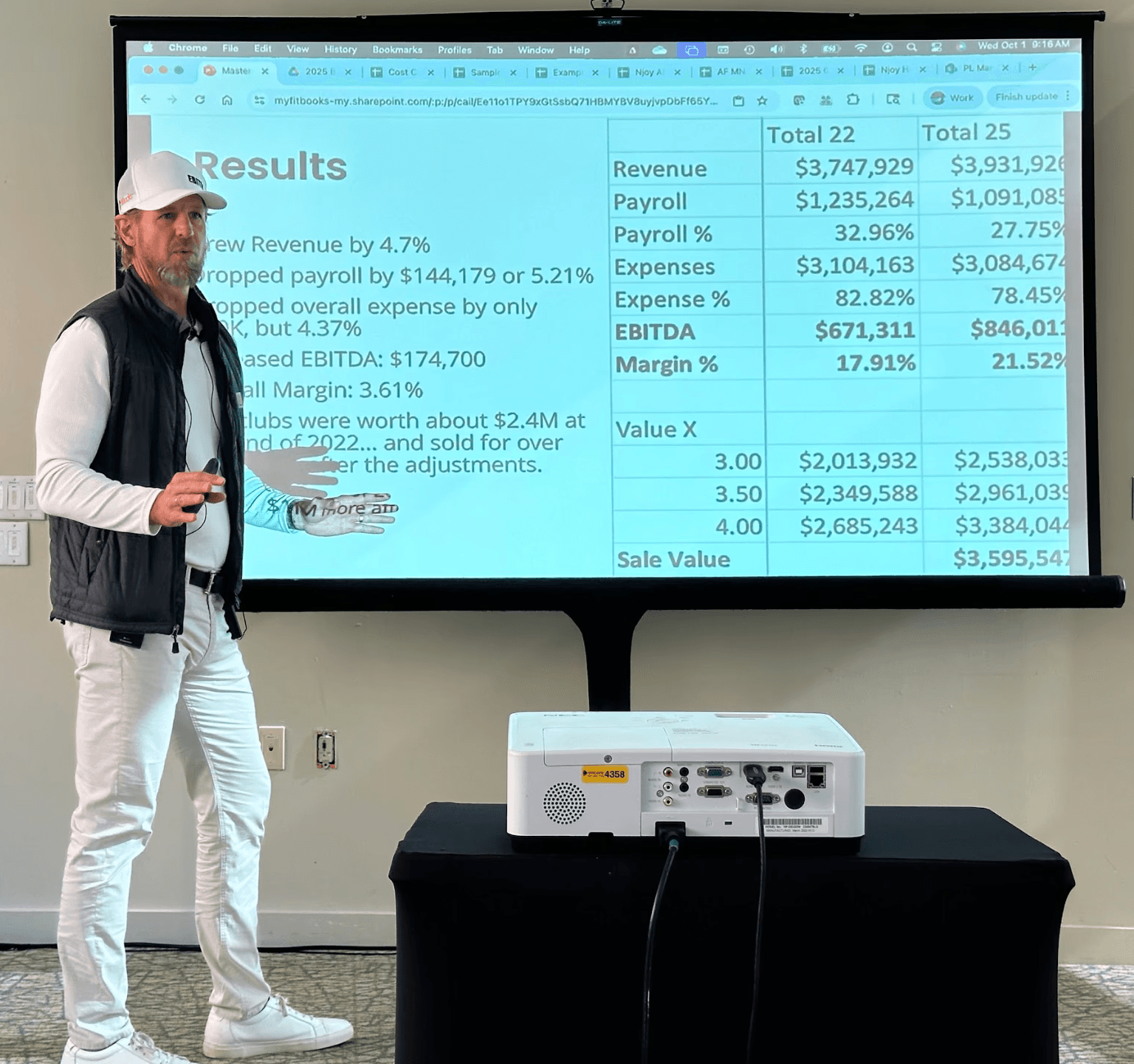
Let's start with the basics. If you sell $100,000 in a period, you should be able to take $20,000 as net income. That's what we mean by a 20% profit margin.
Across most fitness brands—whether Anytime Fitness, boutique studios, or regional chains—the benchmark is consistently 15-25%. Some high-volume, low-price gyms like Planet Fitness and Crunch run tighter at around 10%.
Want perspective? Grocery stores operate on 1-3% margins. Everything is razor thin. They have to be incredibly good at logistics and operational efficiency just to survive.
So 20% is strong. But it's not a one-size-fits-all number.
Why Your Area Matters
Don't beat yourself up if you're not at 20%. And definitely don't compare yourself blindly to someone in a different market.
Some gym owners pay $3,000 in rent. Others pay $13,000. If your friend is hitting 40% profit margins in a low-rent market while you're at 16% in a high-cost area, it doesn't mean you're terrible. It means you need to look under the hood to determine what's realistic for your specific situation.
I know Anytime Fitness locations running at 37-40% four-wall profit. But those are in specific markets with specific advantages. Your goal should be to optimize for YOUR reality, not someone else's.
Three Key Factors That Influence Profit Margins
1. Operational Efficiency
There is so much waste in most gym operations. I'm dealing with waste in my organization right now—our labor really went up because we wanted to scale a few things, but it's just not producing the efficiency we expected. So we're making changes.
The bigger you get, the more things can get a little wonky. That's why operational efficiency is constantly something you need to audit. Where is money leaking? Where are hours being wasted? Where are resources being misallocated?
2. Membership Retention Rate
As we've all heard: it costs more money to get a new member than to keep an existing one. Your retention rate directly impacts your profit margin.
If you're constantly churning members and spending on acquisition, your margins suffer. If you're keeping members for years through excellent service and strong community, your margins improve dramatically.
3. Additional Revenue Streams
How are you diversifying revenue? Are you offering premium memberships?
Brett Livingstone talked about this at our Mastermind Summit. He's getting close to 50% of his members on what used to be called "premium" memberships, paying around $90 per month on average. And here's the beautiful part: the cost to serve that premium membership is like peanuts. It doesn't cost anything extra.
Compare that to a $200 coaching program, which has a much greater cost to serve. Think about revenue streams that create margin, not just top-line revenue.
Membership and PT Growth Rate Benchmarks
You want to strive for 5-10% growth annually in both memberships and personal training.
Right now, Anytime Fitness as a system is pretty much flat—around 3-3.5% growth. For context, if you're running at that level, you're tracking with the industry leader. But there's always room to push higher.
For example, our PT is up about 11% over prior year. However, memberships are about flat. That tells us something about our business. We're executing well on PT growth but not on membership acquisition. That's not a reason to beat ourselves up—it's information we can use to improve.
Again, comparisons aren't about feeling bad. They're about understanding where you have opportunity.
PT Labor Benchmarks: The 60/40 Rule
Here's a critical benchmark for personal training: 40% of your PT revenue should go to the coach, 60% should go to the house.
If you sell $100,000 in personal training (not top-line revenue, just PT), you should retain $60,000. That's a very efficient PT program.
Now, if you're doing one-on-one training, that's going to be harder to achieve. That's where semi-private and small group training makes a difference. You can serve more clients per hour, which improves your margins dramatically.
A few nuances:
If you're only doing $5,000 in PT and you're paying your trainer $4,000 because you want a good trainer, that's not sustainable. But if you're in the growth phase and you understand this is temporary, that's okay.
If you're doing $20,000 in PT and you're at the 60/40 split, but you're signing 60 new members a month and you need another coach, yes—for about six months you're going to dip below that benchmark. That's expected. Just understand you're in expansion mode and the efficiency will return.
Being able to look ahead and anticipate these fluctuations is key.
Total Labor Benchmarks: The Caveat
Here's where it gets tricky: total labor benchmarks depend heavily on your revenue mix.
If you have a robust PT program (say, 50% of revenue comes from PT), then 35% total labor is a strong benchmark.
If you don't have much PT (maybe $4-5K with a thousand members), your benchmark should be closer to 16-20%.
Why? Because the cost to serve a membership is way different than the cost to serve a PT client. Memberships are low-touch, scalable revenue. PT requires dedicated coach time.
You can't use a one-size-fits-all labor percentage without understanding your revenue composition.
The Mindset: Benchmarks Are Information, Not Judgment
Every time I share these numbers, some gym owners immediately spiral into self-criticism. "I'm only at 12% profit margin. I'm terrible at this."
Stop.
Benchmarks aren't about judgment. They're about information. They tell you where there might be inefficiencies to address. They give you a target to aim for. They help you see what's possible.
But they're not universal truths that apply equally to every market, every business model, every phase of growth.
Use them as guides. Use them to ask better questions:
Where is my operational waste?
How can I improve retention?
What revenue streams have better margins?
Am I scaling too fast or too slow?
Is my labor efficiency in line with my revenue mix?
These are the questions that lead to improvement.
Conducting Your Financial Health Check
Here's your action plan:
Calculate your profit margin. If you're below 20%, don't panic. Ask why. Is it rent? Is it labor? Is it operational inefficiency?
Audit your membership and PT growth rates. Are you growing 5-10% annually? If not, where's the bottleneck? Acquisition? Retention? Both?
Review your PT labor split. Are you at 60/40? If not, is it because you're in a growth phase, or is there a structural problem with your pricing or delivery model?
Assess your total labor percentage. Does it align with your revenue mix? High PT revenue = higher total labor is acceptable. Low PT revenue = you need tighter labor control.
Identify your biggest margin opportunities. Is it premium memberships? Semi-private training? Retention improvements? Operational efficiency?
The Path to the Top 20%
Only 20% of gyms hit the 20% profit margin benchmark. But it's not because the other 80% are incompetent. It's because they haven't systematically addressed the key factors that drive profitability.
Operational efficiency. Retention. Revenue diversification. Labor optimization.
These aren't mysterious secrets. They're knowable, addressable, improvable variables.
Start with your financial health check. Know your numbers. Compare them to the benchmarks. Identify the gaps. Make the adjustments.
And remember: you're not competing with every gym in the country. You're competing with the best version of your own business.
Get your margins right, and everything else gets easier. You can invest in better staff. You can improve member experience. You can open new locations. You can finally take home the income you deserve.
That's what being in the top 20% looks like. And it's absolutely within your reach.
Share lesson:
About Author

Ceo & Strategic Architect
Builder of 30+ fitness studios and advisor to 200+ gyms across North America. Andrew leads Mastermind with a focus on structure, culture, and execution that scales without burnout. He helps owners simplify decisions, align teams, and grow with clarity.
Be notified of new videos & blog posts as soon as they drop
You've been subscribed!